
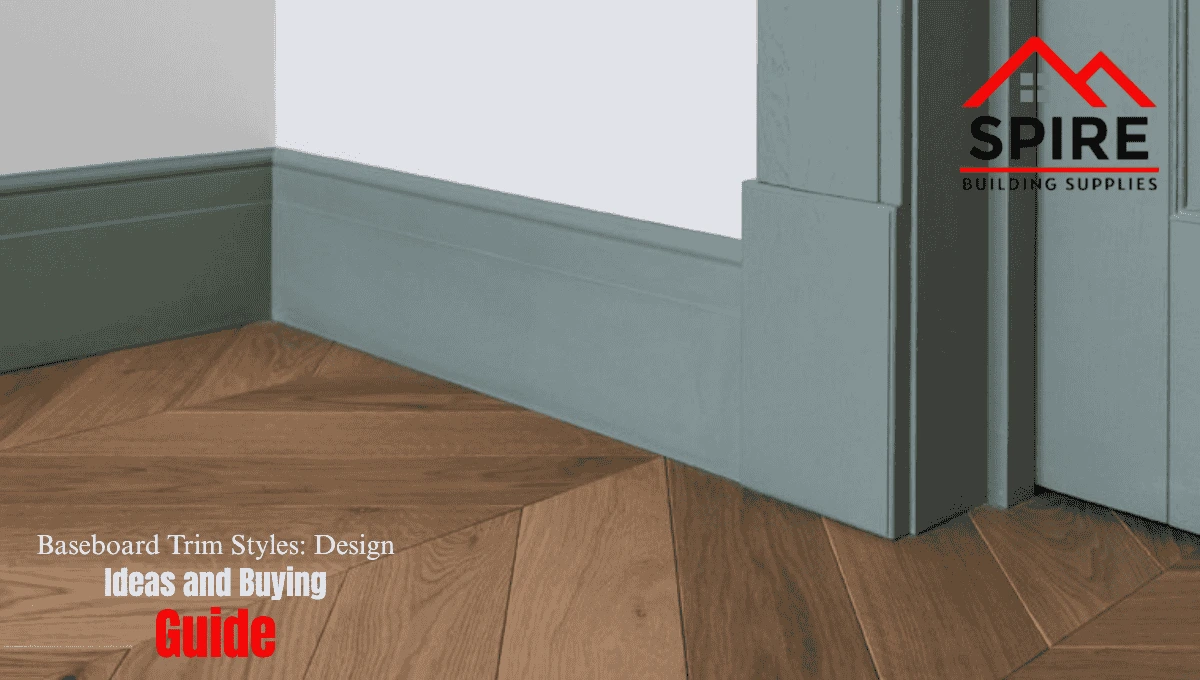
Baseboards are easy to overlook but the moment you walk into a room where they’re done right, you notice. The right baseboard trim styles can ground a space, add architectural character, and make a room feel finished in a way that paint and flooring alone simply can’t. Choose the wrong style or skip the details, and even a beautifully renovated room can feel unresolved.
This guide breaks down the most popular baseboard and trim profiles, how to choose the right one for your home, what to watch out for when buying, and how to install baseboard trim without common mistakes. Whether you’re renovating a single room or outfitting an entire build, you’ll leave with a clear picture of what works and why.
What Is Baseboard Trim and Why Does It Matter?
Baseboard trim is the molding that runs along the bottom of interior walls where they meet the floor. Its practical job is to cover the gap between drywall and flooring protecting the wall from scuffs, moisture, and foot traffic. But its design role is just as important.
Well-chosen trim creates visual continuity between the floor and wall, helps define the overall style of a space, and adds a sense of quality and craftsmanship that’s hard to replicate with other finishes.
Baseboard heights typically range from 3 to 6 inches, with taller profiles generally reading as more formal or high-end.
Common Baseboard Trim Styles Explained
1. Flat (Pencil or Sanitary) Baseboard
This is the simplest profile a flat, straight board with minimal or no detailing. It works well in modern, minimalist, or Scandinavian-inspired interiors where clean lines are the goal. Flat baseboard is often used in commercial spaces and new construction where a streamlined look is preferred.
It’s budget-friendly and easy to install, but it can look stark if the rest of the space has detailed woodwork.
2. Stepped or Colonial Baseboard
One of the most common styles in North American homes, colonial baseboard features a flat middle section with a small stepped cap at the top and a curved or beveled base at the bottom. It has a classic look that suits traditional, transitional, and farmhouse-style interiors without being overly ornate.
This profile pairs well with standard door and window casings, making it easy to maintain a cohesive trim package throughout a home.
3. Ogee or S-Curve Baseboard
The ogee profile uses an S-shaped curve that adds elegance without going into full traditional territory. It’s a popular choice for craftsman-style homes and period renovations, where the trim is meant to feel deliberate and refined. Ogee profiles tend to look best when used consistently with matching casing profiles on doors and windows.
4. Cove Baseboard
Cove profiles feature a concave curve that creates a gentle, softer visual transition from wall to floor. They work particularly well in rooms with rounded architectural details or in spaces aiming for a softer aesthetic — bathrooms and bedrooms especially.
5. Craftsman (Arts & Crafts) Baseboard
Thicker, taller, and more substantial than standard colonial trim, craftsman baseboard is typically 4 to 5 inches tall with a flat face and a simple top cap. It reads as architectural and intentional — less ornate than Victorian styles but with far more presence than flat modern trim.
It suits bungalows, craftsman homes, transitional interiors, and spaces where you want trim that draws the eye without looking fussy.
6. Flexible Baseboard Trim
Not every wall is perfectly straight. In older homes, curved walls, bay windows, and uneven surfaces can make standard rigid trim nearly impossible to install cleanly. Flexible trim solves this — it bends to follow curved surfaces without cracking or gapping.
A good example is the 1X6x10 Straight Flexible Trim Baseboard, which offers the height and visual weight of a wide baseboard while accommodating walls that don’t behave.
How to Match Baseboard Style to Your Interior
Choosing baseboard trim isn’t just about picking a profile you like it needs to work with the room around it.
Consider your ceiling height. Taller ceilings support taller, more detailed trim. In a room with 8-foot ceilings, a 3.5-inch colonial baseboard feels proportional. Push the same room to 5-inch craftsman trim and it can start to look heavy.
Match your door and window casing. The baseboard and casing don’t need to be identical, but they should come from the same design family. A flat, modern baseboard paired with an ornate Victorian casing will look disconnected.
Think about what’s above the baseboard, too. If you’re planning crown molding — like the Crown 4-1/4 x 9/16 FJ Primed — choose a baseboard profile that complements it. A heavily detailed crown with a completely flat baseboard can feel imbalanced.
Factor in floor type. Thick hardwood floors require more clearance at the base of the trim. Thinner vinyl plank or tile can work with a wider range of baseboard heights without creating proportion issues.
What to Look for When Buying Baseboard Trim
Material Options
- Solid wood — durable, paintable, and stainable, but susceptible to moisture in humid rooms. Best for living areas and bedrooms.
- MDF (Medium-Density Fiberboard) — smooth, consistent, and takes paint extremely well. Excellent for painted trim in dry areas. Avoid in bathrooms or anywhere moisture is likely.
- Finger-jointed (FJ) pine — budget-friendly and stable, ideal for painted applications. Uses shorter wood pieces bonded together, which makes it less prone to warping than clear pine.
- Flexible PVC or foam — ideal for curved walls or moisture-prone environments. Doesn’t warp, rot, or swell.
Primed vs. Unprimed
Primed trim is ready to paint immediately and saves time on site. Unprimed wood is the right choice if you’re staining or applying a natural finish.
Profile Consistency
When buying trim in multiple pieces, make sure the profiles match exactly especially if sourcing from different batches. Even small deviations can be noticeable at joints.
How to Install Baseboard Trim: Key Considerations
You don’t need to be a finish carpenter to install baseboard trim, but the details matter. Here’s what to know going in.
Measure twice, cut once especially at corners. Inside corners are typically coped (one piece is cut to overlap the profile of the other), while outside corners require precise 45-degree miters. A poorly fit miter joint is one of the most common complaints in DIY trim work.
Account for the floor. Always install flooring before baseboard trim. The trim should sit on top of the finished floor surface, not the subfloor, to cover the expansion gap properly.
Nail placement matters. Nails should hit studs for a secure hold. Use a stud finder and mark locations before you start. Two nails per stud location one near the top edge, one near the bottom prevents the board from bowing outward over time.
Leave a small gap at the floor. Floating floors need room to expand. Don’t nail trim directly into floating flooring.
Caulk and fill before painting. Caulk the top edge of the baseboard where it meets the wall, and fill nail holes with wood filler. These steps make the difference between trim that looks professional and trim that looks installed by a homeowner in a hurry.
For guidance on how the trim package interacts with other millwork in a room including door surrounds our article on pantry door ideas covers complementary trim considerations worth reading.
Common Mistakes to Avoid
Going too short. Standard 2.5-inch baseboard can look like an afterthought in most rooms. A minimum of 3.5 inches reads as intentional.
Ignoring the rest of the trim package. Buying baseboard without thinking about door casing, window casing, and crown molding creates visual inconsistency. Plan the full trim package before purchasing.
Buying the wrong material for the room. MDF baseboard in a bathroom is a common and costly mistake. Use moisture-resistant materials anywhere humidity is a factor.
Skipping the primer coat on raw wood. Raw trim absorbs paint unevenly. Always prime before the finish coat, even if the trim claims to be paint-ready.
Not buying enough. Add at least 10–15% to your linear footage estimate to account for waste, cuts, and damaged pieces.
Expert Tips for a Better Result
- Sand primed trim lightly before painting factory primer can be rough and will show through the finish coat.
- Use painter’s tape on the floor, not the wall, to protect finished flooring during installation.
- If you’re matching existing trim in an older home, bring a small sample piece when shopping profiles that sound identical often aren’t.
- In rooms with high humidity (bathrooms, laundry), consider a continuous bead of construction adhesive along the back of the trim in addition to nails.
- For wide, tall baseboards, a second piece of trim (a small cap molding) at the top can give extra depth and shadow detail without needing a single oversized piece.
FAQ:
What is the most popular baseboard trim style?
Colonial baseboard is the most widely used profile in North American homes. It has a stepped, slightly detailed shape that works with traditional, transitional, and farmhouse interiors. Craftsman-style baseboard is a close second and is gaining popularity in renovations.
How tall should baseboard trim be?
For standard 8-foot ceilings, 3 to 4 inches is a common range. For 9-foot ceilings and above, 4 to 5.5 inches reads more proportional. Taller trim in a room with low ceilings can make the space feel cramped.
Can I install baseboard trim over carpet?
Yes, but it requires care. The trim should be installed at the right height so it sits just above the carpet pile. Some installers use a carpet scrap as a spacer to get the correct gap.
What’s the difference between baseboard and base molding?
They’re often used interchangeably. “Baseboard” usually refers to the main flat board that runs along the floor. “Base molding” can refer to the full assembly, including a base cap (on top) and base shoe (at the floor), which add more detail to the profile.
Do I need to hire a professional to install baseboard trim?
Not necessarily. Many homeowners with basic carpentry skills and a miter saw can successfully install baseboard trim in straightforward rooms. Tight, complex spaces with lots of angled walls, curved surfaces, or difficult transitions are better handled by a finish carpenter.
What Our Customers Are Saying
We used flexible trim throughout our older home where the walls were far from straight. The difference versus rigid trim we tried before was immediate no gaps, no cracking. Really happy with the result. — Kevin M., homeowner renovation project
I appreciated having someone walk me through the full trim package baseboard, casing, and crown before I ordered. Made a huge difference in how cohesive everything looked once it was installed. — Sandra T., general contractor client
Final Thoughts on Choosing the Right Baseboard Trim
Baseboard trim is one of those finishing details that people rarely notice when it’s done well but always notice when it’s not. The right profile, height, and material can make a room feel complete and intentional. The wrong choice, or a rushed installation, can undermine everything else you’ve invested in a space.
The good news is that with a little planning upfront matching your trim to your interior style, choosing the right material for the room, and taking the time to install it properly baseboard trim is one of the most rewarding upgrades you can make. It’s relatively affordable, visible in every room, and delivers a level of polish that’s hard to achieve any other way.
Whether you’re starting fresh in a new build or updating the trim in a renovation, take the time to get it right. Measure carefully, plan the full trim package before you buy, and don’t cut corners on the finishing steps. The result will speak for itself.
Browse Spire Building Supplies‘ full range of trim profiles and baseboard options to find the right fit for your project.
About the Spire Building Supplies Editorial Team
The content team at Spire Building Supplies draws on years of hands-on experience in residential and commercial construction, trim carpentry, and building materials. Our goal is straightforward: give you accurate, practical information that helps you make better decisions whether you’re a first-time DIYer or a seasoned professional. We know what works in the field, and we write for people who need real answers, not marketing copy.






Leave a comment