
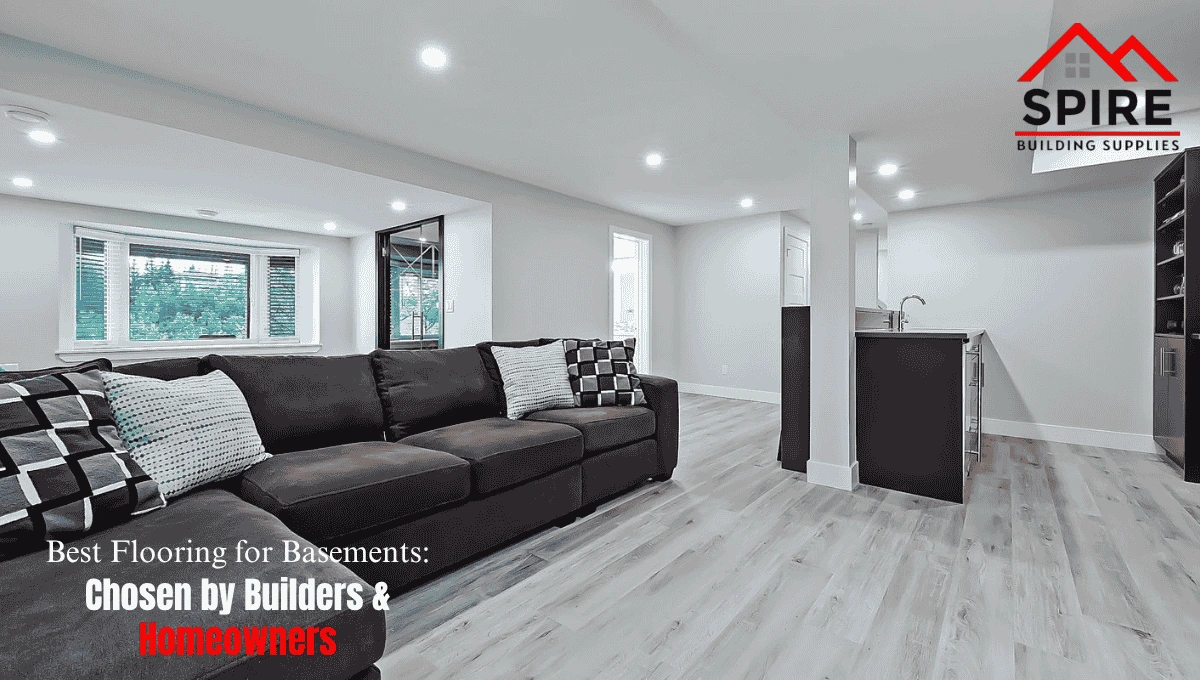
Basements are one of the trickiest spaces to floor. The conditions underground are nothing like the rest of your home moisture migrates up through concrete, temperatures fluctuate, and if water ever gets in, the wrong floor becomes an expensive mistake fast. Choosing the best flooring for basements isn’t just about looks. It’s about picking materials built to handle what a basement actually throws at them.
This guide breaks down the most reliable options, explains what matters most when comparing them, and helps you avoid the common errors that lead to warped floors, mold problems, and wasted money.
Why basements need different flooring rules
Most homes are built on a concrete slab or have a poured concrete basement floor. Concrete is porous. Even when it looks and feels dry, moisture vapor moves through it constantly — especially in humid climates or during rainy seasons. That moisture is the main reason hardwood and standard laminate fail in basements so often.
Beyond moisture, basements also deal with:
- Temperature swings between seasons
- Reduced airflow and ventilation
- Potential for flooding or minor water intrusion
- Heavier foot traffic if used as a rec room or home gym
Any flooring you choose should be able to handle all of the above — not just look good on install day.
The best flooring options for basements
Top Pick
Waterproof
Luxury Vinyl Plank (LVP)
Waterproof core, realistic wood look, warm underfoot, easy to install. Best overall for most basements.
Budget-Friendly
Vinyl Sheet Flooring
Seamless, fully waterproof, and the most affordable option. Great for utility or laundry areas.
Durable
Ceramic or Porcelain Tile
Completely waterproof and extremely durable. Cold underfoot — pair with radiant heat if comfort matters.
Comfort
Engineered Hardwood
More stable than solid wood in humidity. Use only above-grade or at-grade — not in wet basements.
Luxury Vinyl Plank the clear frontrunner
If there’s one flooring type that consistently performs well in basements, it’s luxury vinyl plank. The best LVP flooring features a 100% waterproof core, which means standing water and moisture vapor don’t damage the planks themselves. It installs as a floating floor — no glue, no nails — which allows it to move slightly as temperatures change without buckling or gapping.
Modern LVP also looks genuinely good. The embossed texture and realistic wood grain have improved dramatically in recent years, and options like the Amber Escape Luxury Vinyl Tile and Plank (6mm) and the Explorer’s Cove Luxury Vinyl Tile and Plank (5mm) deliver that warm, finished look without any of the moisture risk that real wood carries.
For most homeowners and builders finishing a basement to livable standard, best rated vinyl plank flooring is the practical, reliable choice and it’s what most professionals reach for first.
Pros
- 100% waterproof core
- Comfortable and warm
- Easy floating install
- Looks like real wood
- Durable with heavy use
Cons
- Can’t be refinished
- May feel hollow on uneven slabs
- Quality varies significantly by brand
Tile flooring best for wet basements
Ceramic and porcelain tile are the most waterproof options available, full stop. If your basement has a history of water intrusion or sits in a flood-prone area, tile is your safest bet. It won’t absorb moisture, it won’t harbor mold underneath, and it’s extremely hard-wearing.
The downside is comfort. Tile is hard and cold fine for a utility room or workshop, less ideal for a finished family space. If you go with tile in a living area, consider a radiant heating system underneath, which transforms the feel of the space entirely.
Engineered hardwood sometimes appropriate
Engineered hardwood has a plywood core that handles humidity better than solid wood, but it’s still not fully waterproof. Use it in basements only when moisture levels are consistently low and the space is climate-controlled year-round. Even then, a thorough moisture test before installation is non-negotiable.
What to avoid
Solid hardwood and standard laminate are both genuinely bad choices for basements. Solid wood swells, warps, and cups when exposed to even moderate humidity. Traditional laminate has a fiberboard core that swells irreversibly when wet. Neither belongs underground no matter how well the rest of the room is finished.
What actually matters when choosing basement flooring
Before picking a product, answer these questions honestly:
- Has water ever gotten in? Even once is enough to shift you toward waterproof-only options.
- What’s the moisture level of the slab? Do a calcium chloride test or use a moisture meter before you buy anything.
- How will the space be used? A rec room, gym, office, and utility space each have different demands.
- What’s your subfloor condition? LVP can handle minor imperfections; tile and engineered wood need a flatter, more level surface.
- How much thickness can you afford? Thicker flooring raises floor height and can affect door clearance and stair transitions.
You can explore a wide range of flooring options at Spire Building Supplies to compare specs side by side once you’ve answered those questions.
Common mistakes to avoid
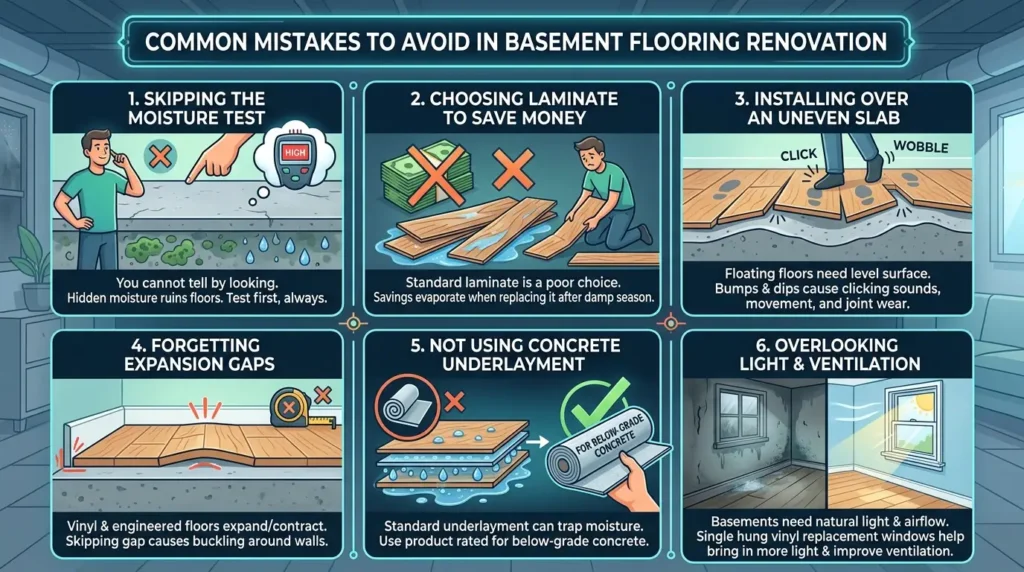
- Skipping the moisture test. The most common and costly mistake. You cannot tell by looking whether a concrete slab has a moisture problem. Test first, always.
- Choosing laminate to save money. Standard laminate is one of the worst choices for basements. The savings evaporate when you’re replacing it after the first damp season.
- Installing over an uneven slab. Floating floors need a level surface within manufacturer specs. Bumps and dips cause clicking sounds, movement, and premature joint wear.
- Forgetting expansion gaps. Vinyl and engineered floors expand and contract with temperature. Leave the gap the manufacturer specifies around every wall skipping this causes buckling.
- Not using underlayment designed for concrete. Standard underlayment can trap moisture against your floor. Use a product specifically rated for below-grade concrete installation.
- Overlooking light and ventilation. Basements are often low on natural light and airflow. If you’re also replacing windows in the renovation, single hung vinyl replacement windows can help bring in more light and improve ventilation alongside your new floor.
Expert tips for a lasting result
Run the moisture test before anything else A calcium chloride test or relative humidity probe gives you an accurate reading. Most LVP manufacturers specify a maximum moisture emission rate if your slab exceeds it, you need to address it before laying any floor.
- Let your flooring acclimate in the basement for 48 hours before installation temperature equalization prevents post-install gaps and buckling.
- Opt for thicker LVP (8mm and above) if your slab has minor dips or imperfections the extra rigidity masks small irregularities better.
- Choose a wear layer of at least 12 mil if the space sees heavy foot traffic, pets, or furniture movement.
- Consider warm-toned planks in below-grade spaces they counteract the naturally cool, dim feel of most basements and make the room feel more inviting.
- Don’t install in the middle of summer or winter without the HVAC running extreme temperature conditions at install can affect how the floor settles.
What homeowners and builders say
We finished our basement last spring and went with LVP throughout. It’s been through one humid summer and one cold winter not a single plank has moved or buckled. Wish we’d done it years ago.
— David K., homeowner, Ohio
As a contractor, I’ve tried just about everything in basements. LVP is what I spec now for every finished basement job. The quality product options have gotten so good — clients always love the result.
— Mike R., residential builder
We had water come in once before we sealed the foundation properly. After that, we tiled the mechanical room and used LVP for the rec area. Perfect combination for our situation.
— Sandra L., homeowner, Pennsylvania
People also ask
What is the best flooring for a basement with moisture issues?
Luxury vinyl plank or ceramic tile. Both are 100% waterproof and won’t be damaged by moisture vapor coming through concrete. LVP is the more comfortable option for living spaces; tile is the better call if you’ve had actual water intrusion.
Can you put hardwood floors in a basement?
Solid hardwood, no — it will warp. Engineered hardwood may work in a climate-controlled, dry basement if moisture levels are consistently low, but it still carries more risk than LVP. Most professionals don’t recommend it below grade.
How thick should LVP flooring be for a basement?
At minimum 5–6mm, but 8mm or thicker is better if your slab has any unevenness. Thicker planks hide minor imperfections and feel more solid underfoot. The wear layer should be at least 12 mil for high-traffic areas.
Do I need underlayment for basement flooring?
Yes, and it needs to be the right kind. Use underlayment rated for below-grade concrete installation. It acts as a moisture barrier and adds a small amount of cushion. Some LVP products come with it pre-attached check before buying.
How do I test for moisture in a basement before installing flooring?
Tape a piece of plastic sheeting to the concrete and seal the edges. Leave it for 24–48 hours. If moisture appears on the underside, you have a problem to address. For precise measurements, use a calcium chloride test kit or relative humidity probe both are inexpensive and give reliable readings.
Spire Building Supplies Editorial Team
This guide was put together by the team at Spire Building Supplies a supplier of quality building materials serving homeowners, contractors, and builders. Our content draws on real-world installation experience and hands-on product knowledge to give you advice that’s practical, accurate, and honest. We don’t write to rank we write to help you get the project right the first time.





Leave a comment